

Pro Ligation-Free Cloning MasterMix

| Cat. No. | G4004 | |||||||||||
| Name | Pro Ligation-Free Cloning MasterMix | |||||||||||
| Unit | 50 Reactions | |||||||||||
| Category | Molecular Biology Enzymes and Kits | |||||||||||
| Description |
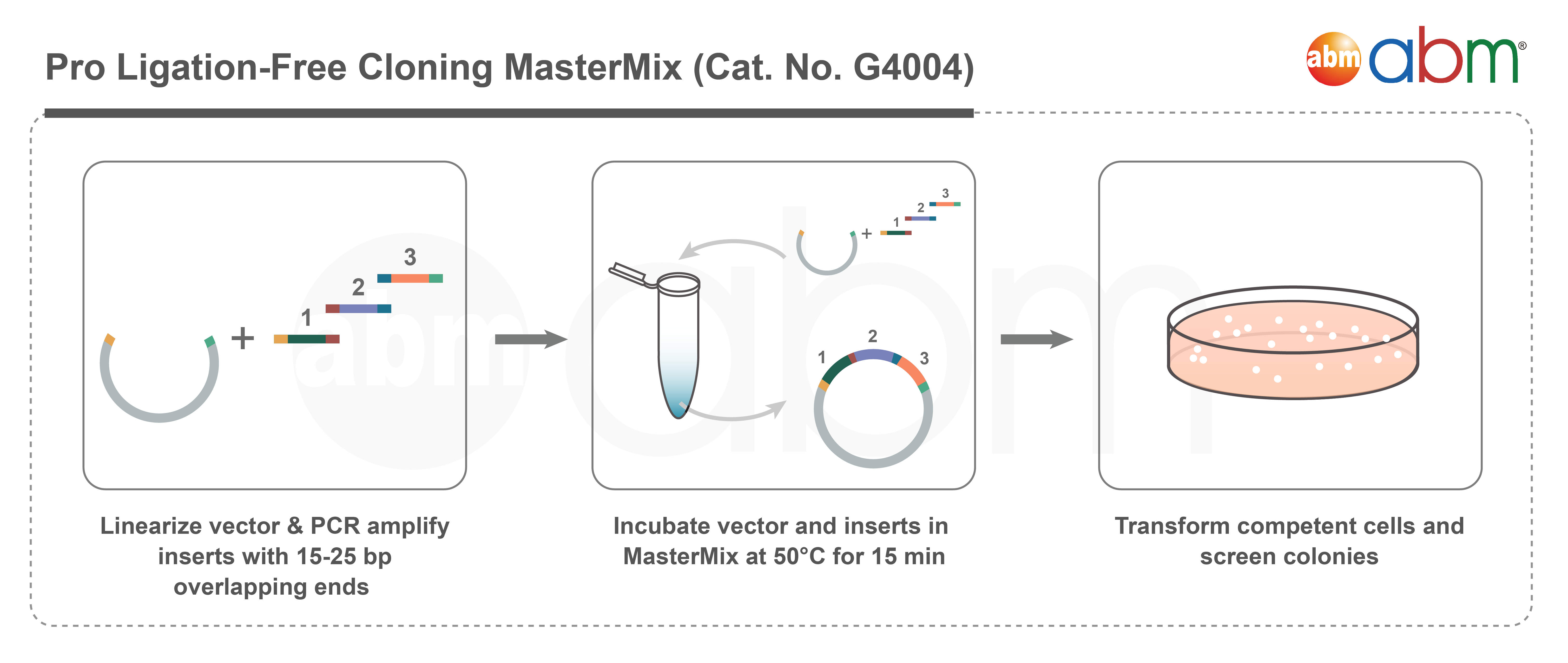
abm’s Pro Ligation-Free Cloning MasterMix is a ready-to-use solution designed for rapid, efficient and seamless DNA assembly regardless of fragment length or end compatibility. It enables one-step assembly of multiple DNA fragments with overlapping ends in a single isothermal reaction making it ideal for synthetic biology and molecular biology applications. To support accurate fragment amplification prior to assembly, the kit includes MegaFi™ Pro Fidelity 2X PCR MasterMix to enable robust, high-fidelity PCR. Key Features:
|
|||||||||||
| Application |
|
|||||||||||
| Storage Condition | Store all components at -20°C | |||||||||||
| Note |
Retired Cat. No. E086 and E087 |
|||||||||||
| Material Citation | If use of this material results in a scientific publication, please cite the material in the following manner: Applied Biological Materials Inc, Cat. No. G4004 |
| How many fragments of DNA can be assembled in one reaction? | |
|
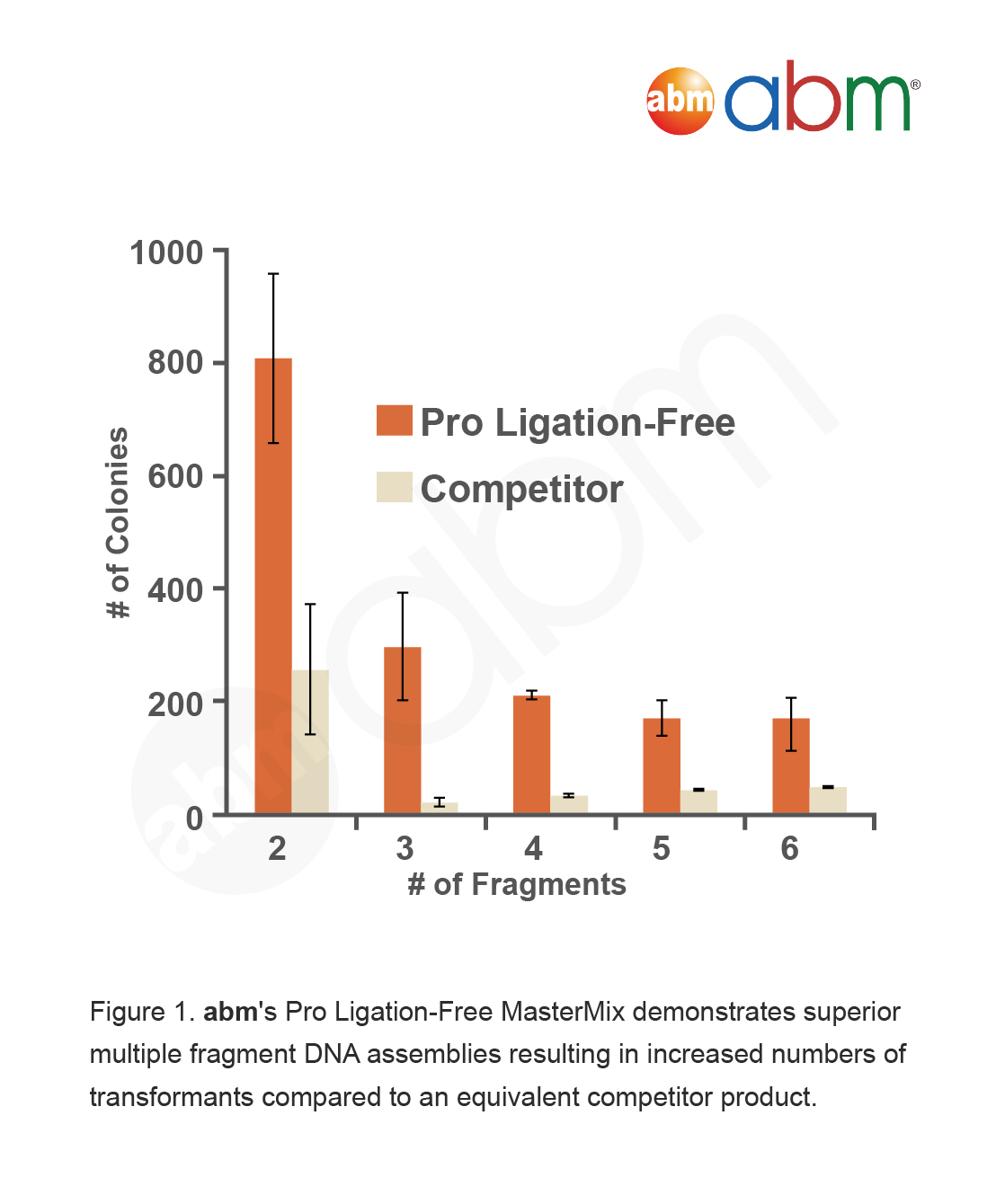
The technology is capable of assembling >10 fragments in a single reaction according to the literature. In house experiments have routinely achieved 6 fragment assemblies.
|
| What are the shortest overlaps that can be used with this assembly method? | |
|
abm recommends a minimum of 15 bp of overlapping sequence with a Tm >50°C. Increasing the length of the overlap can also increase the efficiency of the assembly reaction.
|
| How do I optimize conditions for 3+ fragment assembly? | |
|
abm recommends the following:
1. Setting up the reaction where all components (vector and inserts) are added in equimolar amounts.
2. Increasing the incubation time to 60 min.
3. Utilizing high transformation efficiency electrocompetent E. coli cells.
|
| How do I design overlapping primers for more than one fragment? | |
|
You can use the same logic outlined in the product Datasheet Appendix. See the below image for a multi-fragment assembly example:

|
| Do I need to gel extract and/or purify my DNA fragments before assembly? | |
|
This is an optional but recommended step. Gel purification improves efficiency and accuracy of the DNA assembly especially for complex, multi-fragment assemblies as it removes non-specific PCR products, primer-dimers etc.
|
| After the assembly product has finished incubation, do I need to transform it into competent cells? | |
|
Yes, this is a necessary step that cannot be skipped in the DNA assembly protocol.
|
- Huang, R., Ding, R., Liu, Y., Li, F., Zhang, Z., & Wang, S. A. (2022). GATA transcription factor WC2 regulates the biosynthesis of astaxanthin in yeast Xanthophyllomyces dendrorhous. Microbial Biotechnology, 15(10), 2578-2593. https://doi.org/10.1111/1751-7915.14115
- Hwang, B.-J., Gonzales, R., Corzine, S., Stenson, E., Pidugu, L., & Lu, A.-L. (2022). DNA binding by the Rad9A subunit of the Rad9-Rad1-Hus1 complex. PLOS ONE, 17(8), e0272645. https://doi.org/10.1371/journal.pone.0272645
- Li, L., Liu, W., Fan, N., Li, F., Huang, B., Liu, Q., ... & Wang, X. (2022). Scallop IKK1 Responds to Bacterial and Virus-Related Pathogen Stimulation and Interacts With MyD88 Adaptor of Toll-Like Receptor Pathway Signaling. Frontiers in Immunology, 13. https://doi.org/10.3389/fimmu.2022.869845
- Huang, B., Wu, Y., Ma, J., Yang, B., Sang, X., Chen, J., Liu, W., Li, F., Li, L., Wang, X., Dong, J., & Wang, X. (2022). The first identified invertebrate LGP2-like homolog gene in the Pacific oyster Crassostrea gigas. Fish & Shellfish Immunology, 128, 238–245. https://doi.org/10.1016/j.fsi.2022.08.005
- Sang, X., Liu, W., Li, F., Huang, B., Li, L., Wang, X., Dong, J., Ma, J., Chen, J., & Wang, X. (2022). Scallop RIG-I-like receptor 1 responses to polyinosinic:polycytidylic acid challenge and its interactions with the mitochondrial antiviral signaling protein. Fish & Shellfish Immunology, 124, 490–496. https://doi.org/10.1016/j.fsi.2022.04.042
- Li, M., Tang, J., Yuan, M., Huang, B., Liu, Y., Wei, L., Han, Y., Zhang, X., Wang, X., Yu, G., Sang, X., Fan, N., Cai, S., Zheng, Y., Zhang, M., & Wang, X. (2023). Outer fold is sole effective tissue among three mantle folds with regard to oyster shell colour. International Journal of Biological Macromolecules, 241, 124655. https://doi.org/10.1016/j.ijbiomac.2023.124655
- Tettey, C. K., Mu, X.-Q., Ma, H.-Y., Chen, X.-Y., Geng, C., Tian, Y.-P., Yan, Z.-Y., & Li, X.-D. (2023). The role of different innate and environmental factors in Tm-22-mediated resistance to tomato mottle mosaic virus. Phytopathology Research, 5(1). https://doi.org/10.1186/s42483-023-00162-4
- Novak, N., Baumann, M., Friss, A., Cairns, V., DeMaria, C., & Borth, N. (2023). LncRNA analysis of mAb producing CHO clones reveals marker and engineering potential. Metabolic Engineering, 78, 26–40. https://doi.org/10.1016/j.ymben.2023.05.003
- Chen, J., Qu, Y., Dong, J., Xu, W., Zhao, Y., Cui, J., Yu, Z., Bao, Z., Ma, J., Han, Y., Liu, Y., Huang, B., & Wang, X. (2024). A scallop IκB protein involved in innate immunity acts as a key regulator of NF-κB. Fish & Shellfish Immunology, 154, 109897. https://doi.org/10.1016/j.fsi.2024.109897
- Huang, B., Ma, J., Xu, W., Cui, J., Chen, J., Qu, Y., Zhao, Y., Han, Y., Liu, Y., Wang, W., & Wang, X. (2024). A newly identified scallop MyD88 interacts with TLR and functions in innate immunity. Fish & Shellfish Immunology, 151, 109697. https://doi.org/10.1016/j.fsi.2024.109697
- Tao, Y., Wang, J., Xiao, R., Zhang, Q., & Guo, H. (2024). Development and Evaluation of a Shrimp Virus (IHHNV)-Mediated Gene Transfer and Expression System for Shrimps. International Journal of Molecular Sciences, 25(16), 8999. https://doi.org/10.3390/ijms25168999