

Cell Immortalization Reagents
Immortalized cells are highly preferred over primary cells due to their ability to provide unlimited, consistent access to the same cell line. This eliminates the issues of batch-to-batch variability and the high costs associated with primary cell use.
As a pioneer in cell immortalization technology, abm offers:
-
- 20+ years of immortalization experience
- Comprehensive selection of immortalization viruses for any application
- 600+ immortalized cell lines developed
- Human, mouse, rat, bovine, chicken, pet species, etc.
- Published protocols and technical guides
- Cell immortalization services with QC and validation
Our selection features the widest range of reagents and the highest quality standards – areas where competitors simply can't compare. Whether you're seeking ready-to-use cell lines or advanced tools to immortalize your own, abm has you covered.
Recommended immortalization methods by cell type
| Cell type | Recommended method | Notes |
|---|---|---|
| Fibroblasts |
SV40TCDK4 + hTERT
|
High success rate |
| Epithelial cells |
CDK4 + hTERTHPV E6/E7
|
Better phenotype retention |
| Endothelial cells |
hTERT
|
Less transformation |
| Neural stem cells |
Bmi1
|
Maintains progenitor state |
| B cells |
EBV
|
Standard approach |
Recombinant SV40T Virus
| SV40 T Antigen: Proven, Robust, and Versatile |
|
SV40 large T antigen is a gold-standard for efficiently immortalizing primary mammalian cells. It enables continuous proliferation through multiple mechanisms:
• Inactivates p53 and Rb, bypassing cell cycle checkpoints • Activates E2F, driving cells into S phase • Reactivates telomerase, preventing telomere shortening • Stabilizes replication machinery, supporting sustained in vitro growth Whether you're developing epithelial, kidney, or respiratory models, SV40 T antigen ensures robust performance and reliable expansion. |
| Product Name | Cat. No. | Vector Map | Promoter | Marker | Price |
|---|---|---|---|---|---|
| Lentivirus | |||||
Lenti-SV40T (Puro) Virus  |
LV613 | View | CMV | Puro | Inquire |
| Lenti-SV40T (Neo) Virus | LV660 | View | CMV | Neo | Inquire |
| Lenti-SV40T Virus | LV665 | View | CMV | Inquire | |
| Lenti-SV40Tt Virus | LV614 | View | CMV | Puro | Inquire |
| Lenti-SV40 Virus | LV612 | View | SV40 | Inquire | |
| Lenti-SV40T (tsA58 temp sensitive) (Puro) Virus |
LV630 | View | CMV | Puro | Inquire |
| Lenti-SV40T (tsA58 temp sensitive) Virus | LV680 | View |
CMV | Inquire | |
| Adenovirus | |||||
| Adeno-SV40T Virus | G210 | View | CMV | Puro | Inquire |
| Retrovirus | |||||
| Retro-SV40 Virus | G212 | View | 5'LTR | Neo | Inquire |
| Retro-SV40LT Virus | RVP010 | View | CMV | Puro | Inquire |
Recombinant hTERT Virus
| hTERT: Extend Lifespan Without Altering Cell Identity |
|
When native cell function matters, hTERT is the preferred choice. Unlike oncogenic methods, hTERT gently extends cellular lifespan by reactivating telomerase, the enzyme that maintains telomere integrity.
Key Benefits: • Maintains telomeres to support continuous division • Delays senescence without triggering transformation • Preserves phenotype and karyotype • Minimizes genomic instability—ideal for sensitive models Perfect for immortalizing fibroblasts, epithelial cells, or stem-like populations while retaining physiological relevance. |
| Product Name | Cat. No. | Vector Map | Promoter | Marker | Price |
|---|---|---|---|---|---|
| Lentivirus | |||||
| Lenti-hTERT-Puro Virus |
LV615 | View | CMV | Puro | Inquire |
| Lenti-hTERT-Neo Virus | LV622 | View | CMV | Neo | Inquire |
| Lenti-hTERT Virus | LV674 | View | CMV | Inquire | |
| Lenti-hTERT-2A-CDK4 Virus |
LV677 | View | CMV | Puro | Inquire |
| Lenti-EF1a-hTERT Virus | LV616 | View | EF1a | Puro | Inquire |
| Lenti-EF1a-hTERT-Hygro Virus | LV632 | View | EF1a | Hygro | Inquire |
| Adenovirus | |||||
| Adeno-hTERT Virus | G205 | View | CMV | Inquire | |
| Adeno-hTERT Antisense Virus | G208 | View | CMV | Inquire | |
Additional Immortalization Viruses
| Product Name | Cat. No. | Vector Map | Application | Price |
|---|---|---|---|---|
| HPV E6/E7 | ||||
| Lenti-HPV E6/E7 (Puro) Virus |
LV617 | View | Immortalize keratinocytes | Inquire |
| Lenti-HPV E6/E7 Virus | LV667 | View | Inquire | |
| EBV genes (Epstein-Barr Virus) | ||||
| EBV Virus | G229 | N/A | Immortalize B lymphocytes, and sometimes T lymphocytes | Inquire |
| E1A-E1B | ||||
| E1A-E1B Lentivirus | LV652 | View | Immortalize a wide range of primary rodent cells, including amniotic fluid cells, epithelial cells, fibroblasts, and kidney cells | Inquire |
| siRNA | ||||
| Lenti-Rb siRNA Virus | LV621 | View | Co-express with hTERT for better immortalization of epithelial cells | Inquire |
| Lenti-p53 siRNA Virus | LV619 | View | Inquire | |
| Bmi1 | ||||
| Lenti-Bmi1 Virus | LV608 | View | Immortalize epithelial cells | Inquire |
| CDK4 | ||||
| Lenti-hTERT-2A-CDK4 Virus |
LV677 | View | Co-express with hTERT for a more authentic cell model | Inquire |
| Lenti-CDK4 Virus | LV609 | View | Inquire | |
| Myc T58A (c-Myc), Ras V12 (H-Ras) | ||||
| Lenti-Myc T58A Virus | LV618 | View | Immortalizes a wide variety of cells, including neural stem cells, primary kidney cells, erythroblasts, and a variety of epithelial cells | Inquire |
| Lenti-Ras V12 Virus | LV620 | View | Inquire | |
| HOXB8, HOXA9, HOXA10 | ||||
| Lenti-HOXB8-RFP Virus | LV638 | View | Immortalize hematopoietic cells, including macrophages, hematopoetic progenitor cells, and myeloid progenitor cells | Inquire |
| Lenti-HOXA9-RFP Virus | LV644 | View | Inquire | |
| Lenti-HOXA10-RFP Virus | LV650 | View | Inquire | |
| Other Related Reagents | ||||
| ViralEntry™ Transduction Enhancer (100X) | G515 | Boosts lentiviral transduction | Inquire | |
What Researchers are Saying:
| “Stable proliferation over 50 passages.” |
|
“We successfully established an immortalized bottlenose dolphin kidney cell line using SV40 large T antigen lentivirus from abm… retaining epithelial morphology.”
— Tashiro et al., 2023, In Vitro Cell. Dev. Biol. - Animal. DOI: 10.1007/s11626-023-00786-y |
| “Ideal for long-term virus pathogenesis studies.” |
|
“Immortalization of feline respiratory epithelial cells using abm's SV40 lentivirus allowed differentiation in ALI culture and FHV-1 infection studies.“
— Lee et al., 2023, Virus Research. DOI: 10.1016/j.virusres.2023.199063 |
| “Reliable immortalization with preserved phenotype.” |
|
“We used abm’s Lenti-hTERT-Neo Virus along with p53 siRNA virus to immortalize human kidney cells. Stable lines were selected 48 hours post-transduction using 800 μg/mL G418.“
— Harafuji et al., 2023, Frontiers in Cell and Developmental Biology. DOI: 10.3389/fcell.2023.1270980 |
| “Immortal feline epithelial cells with >20 passages.” |
|
“Feline respiratory epithelial cell (FREC) immortalization was performed by Applied Biological Materials Inc. The resulting iFRECs could be passaged over 20 times, while primary FRECs did not survive beyond two. Expression of SV40T and HPV16 E6/E7 was confirmed by RT-qPCR at passage 8.“
— Lee et al., 2023, Virus Research. DOI: 10.1016/j.virusres.2023.199064 |
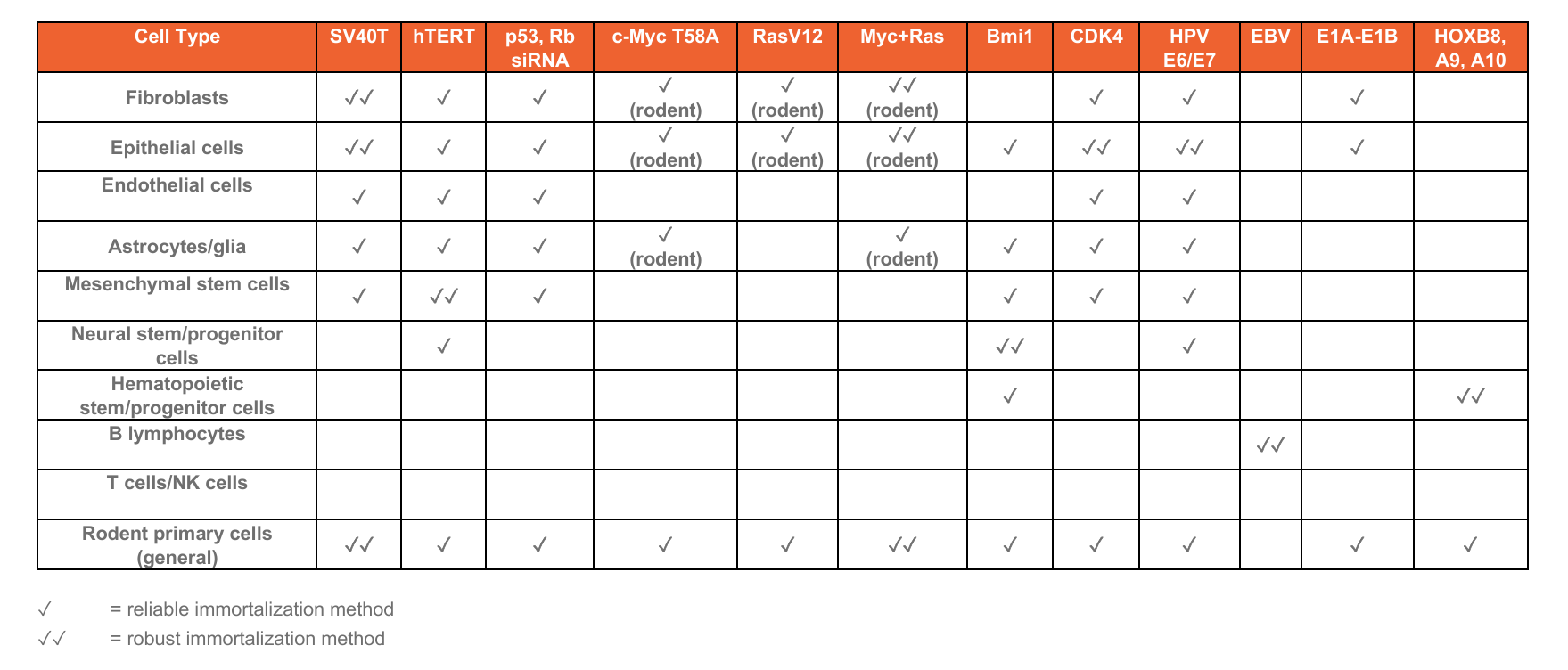
Cell Immortalization Reagents Compatibility Chart
Additional Resources
Additional Information
-

Cell Immortalization Handbook
This Handbook provides an overview of methods, protocols, and reagents. -

Cell Immortalization Workflow
For more information, visit our Cell Immortalization Learning Resource. -

Custom Cell Immortalization Service
Our scientists can immortalize your cell line of choice.
Documents

Top Publications
Establishment and characterization of imortalized sweat gland myoepithelial cells.
Hayakawa T. et al.
Scientific Reports (2022)
doi: 10.1038/s41598-021-03991-5
Integrative analyses of human reprogramming reveal dynamic nature of induced pluripotency.
Cacchiarelli D. et al.
Cell (2015)
doi: 10.1016/j.cell.2015.06.016
Tumor-penetrating therapy for β5 integrin-rich pancreas cancer.
Hurtado T. et al.
Nature Communications (2021)
doi: 10.1038/s41467-021-21858-1
Frequently Asked Questions About Cell Immortalization
What is cell immortalization? →
Cell immortalization is the process of enabling primary cells to proliferate indefinitely by overcoming cellular senescence. Immortalized cells maintain the ability to divide beyond the normal lifespan of primary cells and are widely used for drug discovery, disease modeling, protein production, and basic research.
Why do primary cells stop dividing? →
Most primary cells undergo replicative senescence after a limited number of cell divisions. This occurs due to telomere shortening, DNA damage responses, and activation of cell cycle checkpoints involving pathways such as p53 and Rb.
What are the most common methods of cell immortalization? →
Common immortalization methods include expression of hTERT (human telomerase reverse transcriptase), SV40 Large T Antigen, HPV E6/E7 proteins, CDK4, Bmi1, and combinations of these factors. The optimal method depends on the cell type and intended application.
What is hTERT-mediated immortalization? →
hTERT-mediated immortalization involves expression of human telomerase reverse transcriptase to maintain telomere length and extend cellular lifespan. This approach often preserves normal cell characteristics better than viral oncogenes and is commonly used for epithelial cells, endothelial cells, and stem cell-derived models.
What is SV40 Large T Antigen? →
SV40 Large T Antigen is a viral protein that promotes cell proliferation by inactivating key tumor suppressor pathways, including p53 and Rb. SV40 is highly effective for immortalizing many primary cell types, especially fibroblasts and difficult-to-expand cells.
What is the difference between hTERT and SV40 Large T Antigen? →
hTERT primarily extends cellular lifespan by maintaining telomeres, whereas SV40 Large T Antigen bypasses cell cycle checkpoints. hTERT often better preserves normal cellular phenotype, while SV40 generally provides higher immortalization efficiency. Some cell types benefit from a combination of both approaches.
Can immortalized cells replace primary cells? →
Immortalized cells provide a consistent and renewable research model but may not fully replicate all characteristics of primary cells. Researchers should validate key biological functions and markers relevant to their experimental objectives.
How many passages can immortalized cells undergo? →
Properly immortalized cell lines can typically be cultured for hundreds of passages and may proliferate indefinitely under appropriate culture conditions. Actual lifespan depends on the immortalization strategy, cell type, and culture practices.
Can human primary cells be immortalized? →
Yes. Human fibroblasts, epithelial cells, endothelial cells, mesenchymal stem cells, renal cells, airway cells, and many other primary cell types can be successfully immortalized using appropriate genetic approaches.
Can animal cells be immortalized? →
Yes. Cell immortalization has been successfully performed in mouse, rat, canine, feline, bovine, porcine, avian, and numerous other species. The optimal immortalization strategy may vary depending on species and tissue source.
What cell types can be immortalized? →
Many cell types can be immortalized, including fibroblasts, epithelial cells, endothelial cells, neuronal cells, mesenchymal stem cells, keratinocytes, airway cells, kidney cells, hepatocytes, and various immune cell populations.
Will immortalization change cell phenotype? →
Some changes in gene expression, proliferation rate, or cellular behavior may occur following immortalization. The extent of these changes depends on the immortalization method used and the biology of the original cell type. Validation studies are recommended following establishment of an immortalized cell line.
Are immortalized cells tumorigenic? →
Immortalization does not necessarily result in tumorigenicity. However, certain immortalization methods may alter growth control pathways. Researchers should evaluate tumorigenic potential when relevant to their application.
How long does cell immortalization take? →
The development of an immortalized cell line typically requires several weeks to several months, depending on the cell type, transduction efficiency, selection strategy, and validation requirements.
How do researchers verify successful immortalization? →
Successful immortalization is commonly confirmed through long-term proliferation studies, population doubling analysis, marker expression testing, morphology assessment, telomerase activity measurements, and other functional assays specific to the cell type.
What are the advantages of immortalized cell lines? →
Immortalized cell lines provide a renewable cell source, improved experimental reproducibility, reduced donor-to-donor variability, lower long-term costs, and support for large-scale research and screening applications.
Which immortalization method is best? →
No single immortalization strategy is optimal for every cell type. hTERT is often preferred when preserving normal cellular characteristics is important, while SV40 Large T Antigen may be selected when higher immortalization efficiency is required. Combinatorial approaches are frequently used for challenging primary cells.