

USA academic researchers, shop worry-free—no tariffs*, just science!
Details
- Home
- Genetic Materials
- Expression-Ready Libraries
- siRNA
- siRNA dsRNA Oligo
CLOSE
All Products
- General Materials
-
Cellular Materials
- Cell Library Collections
- Special Cell Line Collections
- 3D and Organoid
- Microbial Contamination
- Cell Immortalization Reagents
- Media & Supplements
- Growth Factors and Cytokines
- Culture Consumables
- Cell Assay Products
- Cell Culture Equipment
- Genetic Materials
siRNA dsRNA Oligo Library
siRNAs are potent gene-silencing tools that can be delivered via double-stranded RNA (dsRNA) for rapid, transient knockdown without modifying the host genome. Suitable for both in vitro and in vivo applications, abm provides pre-designed sets of three siRNA oligo duplexes targeting any human, mouse, or rat gene, along with effective controls. These duplexes can be transfected individually or pooled for enhanced knockdown efficiency.
Search our collection of siRNA Technology products using Gene symbol or Accession number:
Search results will be displayed here
Key Features:
- Produced under ISO9000 standards.
- HPLC purified >97%.
- Chemically modified (2’-OMe) for increased stability and lower toxicity.
- 19-23 bases for each duplex in lyophilized format.
- Set of 3 siRNA oligo duplexes for enhanced gene knockdown.
- Included positive and negative controls.
- Guaranteed knockdown of at least 70% in every set.
Additional Information
-

Mechanism
Click to view. -
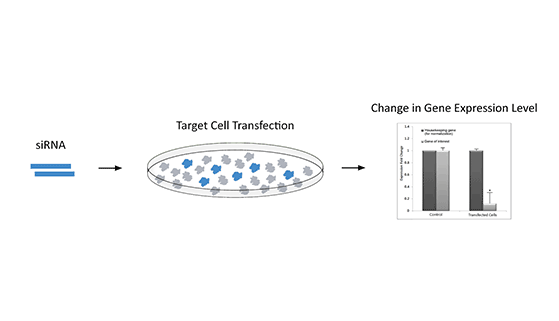
Workflow
Click to view. -
siRNA Oligo User Instructions
Click to download.

FAQs
| What are siRNA dsRNA oligos? |
|
siRNA dsRNA oligos are short, chemically synthesized double-stranded RNA molecules designed to specifically target and degrade complementary mRNA, resulting in transient gene silencing.
|
| How do synthetic siRNA oligos differ from vector-based RNAi? |
|
Synthetic siRNA oligos are delivered directly into cells and produce rapid, transient knockdown, whereas vector-based RNAi systems rely on intracellular expression and typically provide longer-lasting gene silencing.
|
| What delivery methods are commonly used for siRNA oligos? |
|
siRNA dsRNA oligos are most commonly delivered using lipid-based or polymer-based transfection reagents. Electroporation may be used for difficult-to-transfect or primary cells.
|
| How long does gene silencing from siRNA oligos last? |
|
Knockdown from synthetic siRNA oligos usually begins within 24-48 hours after transfection and lasts several days, depending on cell type, target gene, and experimental conditions.
|