

Viral Transduction Enhancer

Boost viral transduction by 10X!
Product List
| Product Name | Cat. No. | Application | Size | Price |
|---|---|---|---|---|
| ViralEntry™ Transduction Enhancer (100X) | G515 | Lentivirus | 1.0 ml | $185 |
| AAViralEntry™ Transduction Enhancer (100X) | G516 | AAV | 1.0 ml | $185 |
ViralEntry™ Transduction Reagent
ViralEntry™ is an effective lentivirus transduction enhancing reagent that increases transduction efficiency in diverse cell types, even lymphocytes, by up to 10X. We guarantee that this is the most effective viral transduction reagent in the industry and will provide a full refund if you find a transduction enhancer with superior performance compared to abm’s ViralEntry™ formulations.

Boost transduction efficiency up to 10X

Works with difficult cells (T & B cells)

Easy-to-use: add directly into media
Confident Results
- Cited in 20+ peer-reviewed publications, across a variety of cell lines including THP-1, HEK293T, pMPMEC, MSCs, BMDM, and more!

abm's ViralEntry™ Transduction Enhancer boosts transduction efficiency by up to 10X in a broad range of cells. HEK293T, HeLa, K562, Primary Human T Cells, and Primary Swine Spleen Macrophages were transduced with Scrambled siRNA GFP Lentivirus (Cat. No. LVP015-G) without using a transduction enhancer and using abm's ViralEntry™ Transduction Enhancer (Cat. No. G515).
AAViralEntry™ Transduction Reagent
AAViralEntry™ is also available for enhancing AAV transduction efficiency with low cell toxicity.

Boosts transduction efficiency up to 10X

Works with all AAV serotypes

Easy-to-use: add directly into media
Superior Transduction Efficiency
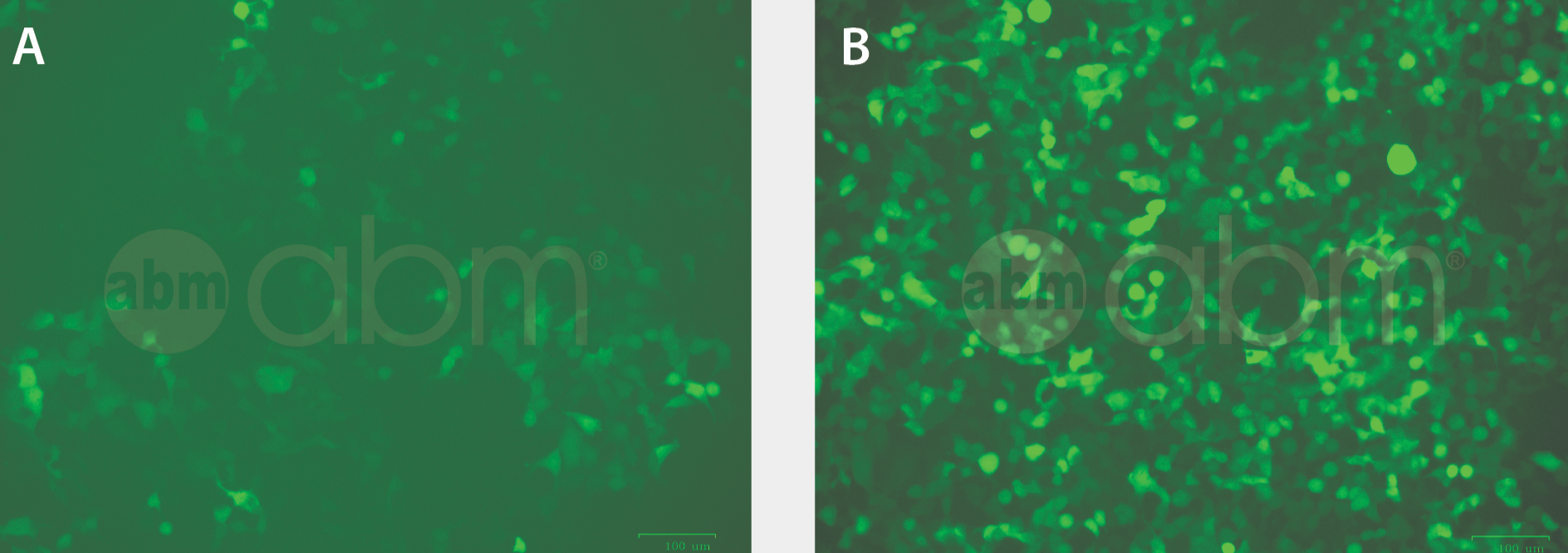
abm's AAViralEntry™ Transduction Enhancer is effective at increasing AAV transduction efficiency. 20-30% confluent adherent HEK293T cells were infected with Scrambled AAV siRNA Control Virus (Serotype 2) (Cat. No. iAAV01502) in the absence (A) and presence (B) of AAViralEntry™ Transduction Enhancer (Cat. No. G516). Images were taken 24 hrs post infection.
Frequently Asked Questions About ViralEntry™ Transduction Enhancer
Find answers to common questions about lentiviral transduction, retroviral infection, primary cell transduction, CRISPR delivery, stable cell line generation, and improving viral transduction efficiency.
What is a viral transduction enhancer? →
A viral transduction enhancer is a reagent that improves the efficiency of viral gene delivery into target cells. These reagents help increase interactions between viral particles and cells, resulting in higher transduction rates and improved expression of delivered genetic material.
What is ViralEntry™ Transduction Enhancer? →
ViralEntry™ Transduction Enhancer is a proprietary reagent developed to improve viral transduction efficiency in a wide range of mammalian cell types. It is designed for use with lentiviral and retroviral vectors and has demonstrated substantial improvements in transduction efficiency in both adherent and suspension cell cultures.
How does ViralEntry™ improve viral transduction? →
ViralEntry™ enhances the interaction between viral particles and target cells, increasing the likelihood of successful viral entry. This results in higher transduction efficiencies and improved expression of delivered transgenes while maintaining excellent cell viability.
What viral vector systems are compatible with ViralEntry™? →
ViralEntry™ is optimized for lentiviral and retroviral transduction applications. It can be used for gene overexpression, gene knockdown, CRISPR-based gene editing, pooled screening applications, stable cell line generation, and cell engineering workflows.
Can ViralEntry™ be used with lentiviral vectors? →
Yes. ViralEntry™ was specifically developed to improve lentiviral transduction efficiency and is compatible with research-grade lentiviral vector systems.
Can ViralEntry™ be used with retroviral vectors? →
Yes. ViralEntry™ can improve retroviral transduction efficiency in many cell types and may be used as part of standard retroviral gene delivery workflows.
Which cell types can be transduced using ViralEntry™? →
ViralEntry™ has been successfully used with HEK293, HEK293T, CHO, Jurkat, K562, NIH3T3, primary T cells, primary B cells, stem cells, macrophages, and other difficult-to-transduce mammalian cells.
Is ViralEntry™ effective for primary T-cell transduction? →
Yes. Primary T cells are often challenging to transduce efficiently. ViralEntry™ can significantly improve lentiviral transduction efficiency in activated primary T cells, making it useful for CAR-T development, TCR engineering, and other cell therapy research applications.
Can ViralEntry™ improve B-cell transduction? →
Yes. Primary B cells are traditionally among the most difficult mammalian cell types to transduce. ViralEntry™ was developed to improve transduction efficiency in B-cell applications where standard methods may provide limited success.
Is ViralEntry™ suitable for stem cell transduction? →
Yes. ViralEntry™ may be used with pluripotent stem cells, induced pluripotent stem cells (iPSCs), and adult stem cells where enhanced viral delivery is desired.
Does ViralEntry™ work with suspension cells? →
Yes. ViralEntry™ is particularly useful for suspension cell lines and primary suspension cultures that often exhibit lower transduction efficiencies than adherent cells.
Can ViralEntry™ be used for CRISPR experiments? →
Yes. ViralEntry™ is compatible with lentiviral CRISPR delivery systems used for gene knockout, CRISPR activation (CRISPRa), CRISPR interference (CRISPRi), pooled screening, and genome engineering applications.
Can ViralEntry™ improve stable cell line generation? →
Yes. Improved transduction efficiency often results in a greater proportion of successfully modified cells, simplifying stable cell line generation.
How does ViralEntry™ compare to polybrene? →
Polybrene is commonly used to improve viral transduction but may cause cytotoxicity, altered cell growth, or cell aggregation in sensitive cell types. ViralEntry™ was developed as a next-generation alternative that provides robust transduction enhancement while maintaining compatibility with a broad range of cell types.
Why is my lentiviral transduction efficiency low? →
Low transduction efficiency can result from insufficient viral titer, poor cell health, suboptimal MOI, improper timing, inefficient viral entry, or the inherent resistance of certain cell types. Using a transduction enhancer such as ViralEntry™ may significantly improve infection efficiency.
What are difficult-to-transduce cells? →
Difficult-to-transduce cells are cells that exhibit poor susceptibility to viral infection under standard conditions. Examples include primary T cells, primary B cells, stem cells, macrophages, dendritic cells, hematopoietic cells, and some suspension cell lines.
Can ViralEntry™ improve transduction of macrophages? →
Yes. Macrophages are often resistant to efficient viral transduction. ViralEntry™ can improve gene delivery efficiency in macrophage research applications.
Does ViralEntry™ affect cell viability? →
When used according to the recommended protocol, ViralEntry™ is designed to provide enhanced transduction efficiency while maintaining high cell viability.
Can ViralEntry™ be used for cell therapy research? →
Yes. ViralEntry™ is commonly used in CAR-T development, T-cell receptor engineering, gene therapy vector evaluation, immune cell engineering, and related cell therapy research applications.
Can ViralEntry™ be used for both transient and stable expression studies? →
Yes. ViralEntry™ supports both transient expression experiments and workflows intended to generate stable genetically modified cell populations.
What applications benefit most from ViralEntry™? →
Applications that commonly benefit include lentiviral transduction, retroviral transduction, stable cell line generation, CRISPR screening, gene overexpression studies, shRNA knockdown experiments, CAR-T development, stem cell engineering, and primary cell modification.
Request a Free Sample
Simply select the free product sample(s) you would like to receive and we will get in touch with you to coordinate the delivery to your lab. Please note that sample availability is limited and honored on a "first come first served" basis and shipping charges may apply.