

Rat Neurons

| Cat. No. | T5001 |
| Name | Rat Neurons |
| Description |
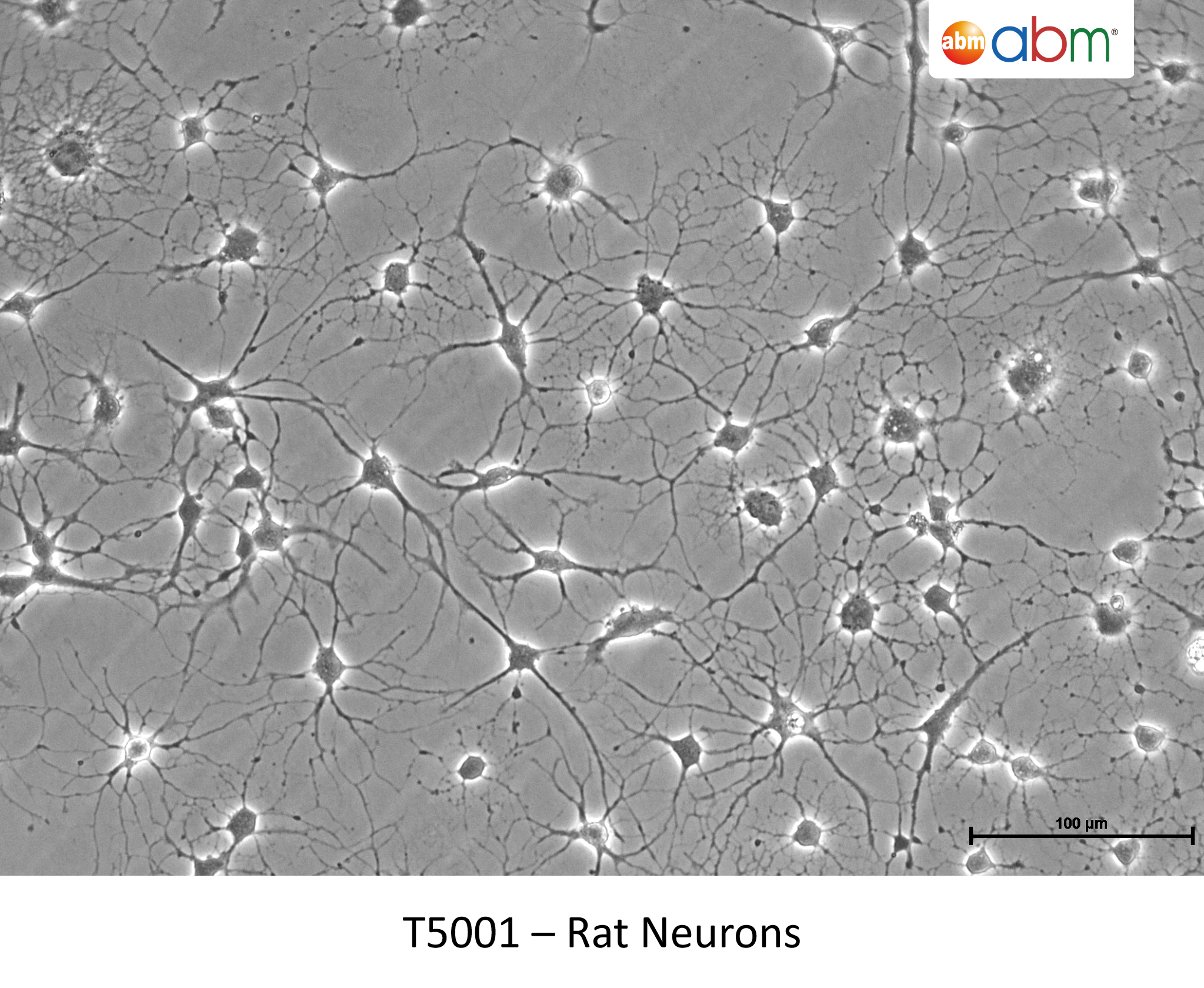
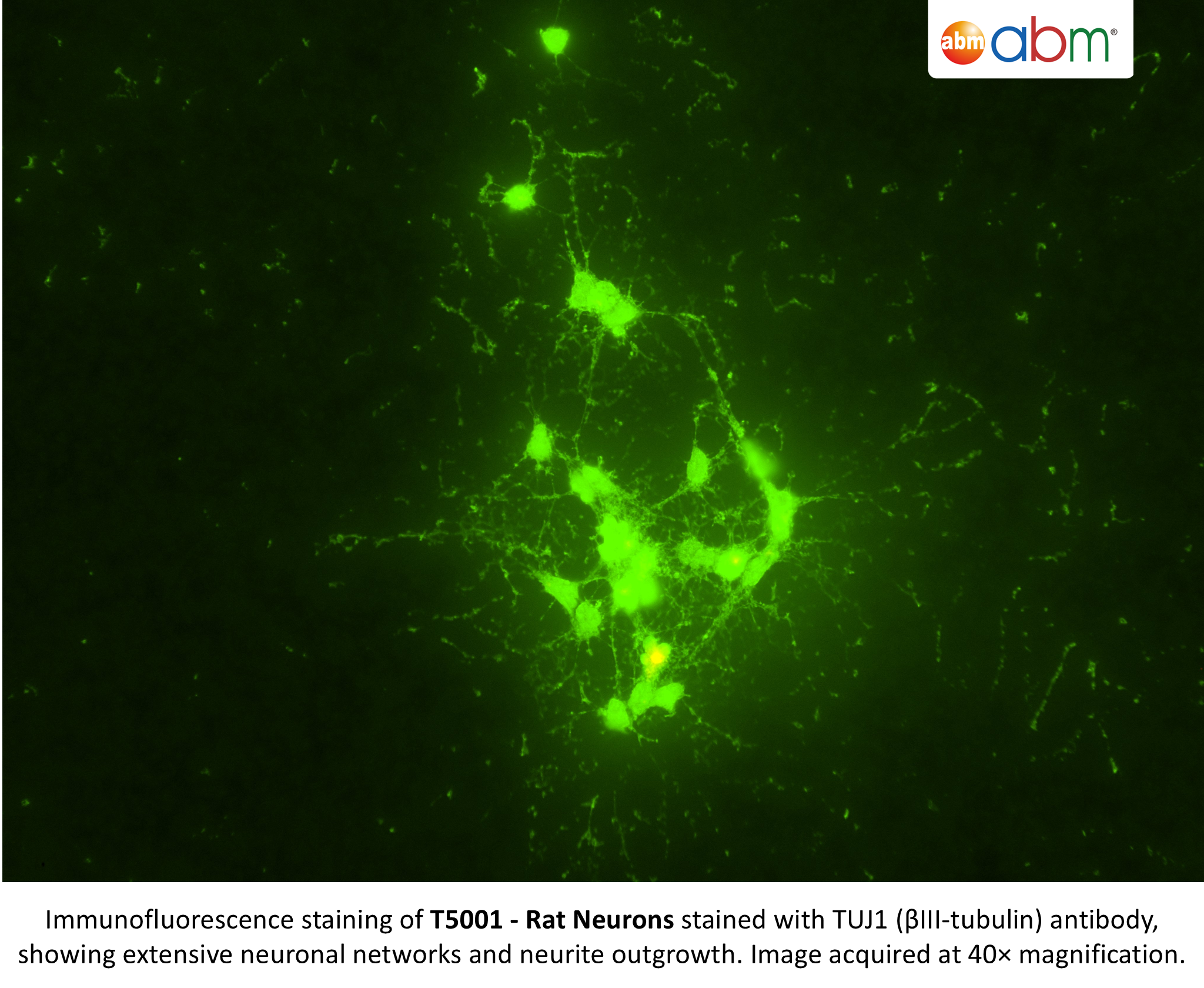
Rat Neurons are differentiated neuronal cells derived from rat neural stem cells, suitable for in vitro neuroscience research. They are used for neuronal function, neurotoxicity, drug screening, and disease-modeling studies. These cryopreserved Rat Neurons provide a convenient, immediately usable, and robust cell source for neuronal research, consistently demonstrating post-thaw viabilities of approximately 60-80% while preserving high neuronal purity. Supplied ready to culture, these neurons provide a reliable, biologically relevant alternative to immortalized cell lines for central nervous system (CNS) research. After being cultured in iNeuraDiffX™ Medium Kit (TM208) for maturation, rat neurons are ready for downstream assays. |
| Organism | Rat (R. norvegicus) |
| Tissue | Brain |
| Growth Properties | Adherent, Neuronal |
| Storage Condition | Vapor phase of liquid nitrogen, or below -130°C. |
| Shipping Conditions | Ship with dry ice. |
| Product Format | Frozen |
| Intended Use | This product is intended for laboratory research use only. It is not intended for any animal or human therapeutic use, any human or animal consumption, or any diagnostic use. |
| BioSafety | II |
| Certificate of Analysis | For batch-specific test results, refer to the applicable certificate of analysis that can be found at www.abmgood.com. |
| Growth Conditions |
For optimal cell culture, we recommend that flasks or plates are coated with 5 µg/mL Poly-L-Ornithine (PLO) (TM062) in 1X PBS and incubated at room temperature for 1 hour or 4°C overnight, then washed 3 times with 1X PBS. Next, coat with 5 µg/mL Laminin in DMEM/F12 (TM004) and incubate at 37°C for 1 hour or 4°C overnight prior to cell seeding. If the flask or plate is not used immediately, add DMEM/F12 and store at 4°C for up to 1 week. iNeuraDiffX™ Medium Kit (TM208) + 1% Penicillin/Streptomycin Solution (G255), 37.0°C, 5% CO₂. |
| Unpacking and Storage Instructions |
1. Visually examine the packaging containers for signs of leakage or breakage. 2. Immediately transfer frozen cells from dry ice packaging to a temperature below -130°C, preferably in liquid nitrogen vapor phase storage, until ready for use. To ensure the highest level of viability, thaw the vial and initiate culture as soon as possible upon receipt. If continued storage is desired, the vial should only be stored below -130°C or in liquid nitrogen vapor phase. Do not store at -70°C, as it will result in loss of viability. |
| Thawing Protocol |
For propagation: 1 vial of cells (~2 millions/vial) with good viability (>90%) can be thawed in 1 well of 6 well plate. For differentiation: 1 vial of cells (~2 millions/vial) with good viability (>90%) can be thawed in 3 T75 flasks. Flasks or plates should be coated with 5 µg/ml Poly-L-Ornithine (PLO) (TM062) in 1X PBS and incubated at room temperature for 1 hour or at 4°C overnight, then washed 3 times with 1X PBS. Next, coat with 5 µg/ml Laminin in DMEM/F12 (TM004) and incubate at 37°C for 1 hour or at 4°C overnight prior to cell seeding. 1. Thawing: - Remove the frozen vial from liquid nitrogen and transfer immediately to a 37°C water bath. - Gently swirl the vial until only a tiny ice crystal remains (~1-2 minutes). Do NOT let it fully thaw in the water bath. - Move the vial to a safety cabinet.
- Use a transfer pipette to transfer all cells from the vial into a conical tube containing 4 ml of TM207.
- Centrifuge gently at 270 × g for 3 minutes to pellet cells. - Carefully remove and discard the supernatant without disturbing the pellet.
- Gently use the transfer pipettre to re-suspend the cells in 1 ml of TM207. - Pipette 3-5 times and observe any clumps. - Count cells using a hemocytometer or automated cell counter, handling very gently.
- Seed rat neurons at a density of 80,000-100,000 cells/cm², depending on vessel size and experiment. - Plate cells slowly and evenly in pre-coated vessels, with TM207. - Avoid vigorous mixing; neurons are fragile immediately after thawing.
- Place cultures in a 37°C, 5% CO₂ incubator immediately. - Replace half the medium after 24 hours. - Monitor cultures daily; handle gently during any medium changes. - Change medium every 1-2 days. Neurons are ready to use in 7 days. Critical Notes: - Rat neurons are extremely sensitive; every step must minimize mechanical, thermal, and osmotic stress. Avoid repeated freeze-thaw cycles. Use gentle techniques for all manipulations to maximize viability and survival. |
| Subculture Protocol |
Volumes given below are for a T75 flask; proportionally increase or decrease the volume as required per culture vessel size. Subculture cells once the culture vessel is ~80% confluent. 1. Wash the culture vessel with 1X PBS. 2. Add 5 ml of pre-warmed Accutase and incubate at 37°C for 5-8 minutes. Observe the cells under a microscope; rounded morphology indicates effective detachment. Gently shake the vessel side-to-side or back-and-forth (not up-and-down) to release cells. If cells are not fully detached, return the vessel to the incubator for 3 additional minutes and repeat step 2. 3. Neutralize Accutase by adding an equal volume of DMEM/F12 (TM004) + 3% FBS (1:1 ratio) and wash the flask 3-5 times. 4. Transfer the cell suspension into a sterile conical tube. Note: For T175 or T225 flasks, split the cell suspension into two tubes to minimize mechanical stress during centrifugation. 5. Wash the flask again with neutralizing solution and combine with the cell suspension in step 4. 6. Centrifuge the tube(s) at 270×g for 3 minutes. 7. Discard the supernatent. 8. Use transfer pipette to re-suspend the cell pellet with 1 ml of TM207, pipetting 3-5 times to break up clumps. If a large pellet is present, add additional media and mix until uniform. 9. Count the cells. 10. Seed the cells into pre-coated culture vessels with TM207 media, at a density of 80,000-100,000 cells/cm², depending on vessel size and experiment. |
| Cryopreservation |
We recommend using serum-free CryoGuard™ Freezing Media (TM078). |
| Warranty | abm warrants that cell lines shall be viable upon initiation of culture for a period of thirty (30) days after shipment and that they shall meet the specifications on the applicable abm Material Product Information sheet, certificate of analysis, and/or catalog description. Such thirty (30) day period is referred to herein as the "Warranty Period”. |
| Disclaimer |
1. Sale of this item is subjected to the completion of a Material Transfer Agreement (MTA) by the purchasing individual/institution for each order. If you have any questions regarding this, please contact us at licensing@abmgood.com. 2. All test parameters provided in the CoA are conducted using abm's standardized culture system and procedures. The stated values may vary under the end-user's culture conditions. Please verify that the product is suitable for your studies by referencing published papers or ordering RNA (0.5 μg, Cat.# C207, $450.00) or cell lysate (100 μg, Cat.# C206, $600.00) to perform preliminary experiments, or alternatively use our Gene Expression Assay Service (Cat# C138). All sales are final. 3. We recommend live cell shipments for ease of cell transfer and this option can be requested at the time of ordering. Please note that the end-user will need to evaluate the feasibility of live cell shipment by taking into account the final destination's temperature variation and its geographical location. In addition, we thoroughly test our cell lines for freeze-thaw recovery. If frozen cells were received and not recovered in your lab under the exact, specified conditions (using recommended culture vessel, media, additional supplements, and atmospheric conditions), a live cell replacement is possible at a cost (plus shipping). 4. All of abm's cell biology products are for research use ONLY and NOT for therapeutic/diagnostic applications. abm is not liable for any repercussions arising from the use of its cell biology product(s) in therapeutic/diagnostic application(s). Please contact a technical service representative for more information. 5. abm makes no warranties or representations as to the accuracy of the information on this site. Citations from literature and provided for informational purposes only. abm does not warrant that such information has been shown to be accurate. 6. abm warrants that cell lines shall be viable upon initiation of culture for a period of thirty (30) days after shipment and that they shall meet the specifications on the applicable abm Material Product Information sheet, certificate of analysis, and/or catalog description. Such thirty (30) day period is referred to herein as the "Warranty Period." |
| Application | Research Use Only. |
| Material Citation | If use of this material results in a scientific publication, please cite the material in the following manner: Applied Biological Materials Inc, Cat. No. T5001 |