

AAV siRNA Library
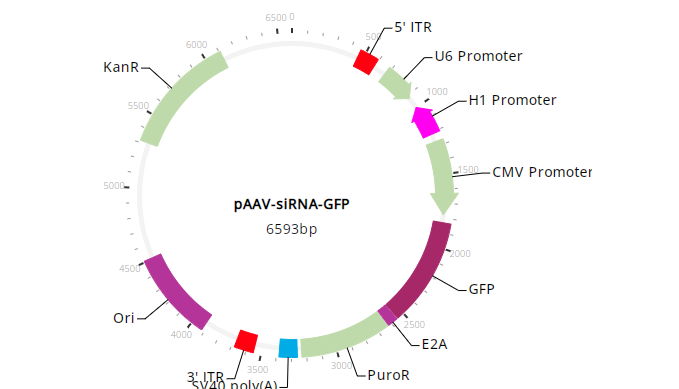
abm’s RNAi Expression System is available in AAV format, enabling efficient siRNA expression with non-integrating delivery for gene therapy. Featuring a unique convergent promoter design, it enhances gene knockdown without requiring a hairpin loop structure. The system includes a GFP reporter for transduction monitoring and offers a comprehensive library of human, mouse, and rat siRNAs in vector or pre-packaged AAV formats (serotypes 1–11) for tissue-specific knockdown.
Search our collection of siRNA Technology products using Gene symbol or Accession number:
Advantages of AAV siRNA:
- Utilizes potent 27-29 bp oligos compared to traditional 19 or 21 bp oligos.
- Features convergent promoters to eliminate hairpin loop structures, simplifying sequencing and plasmid propagation.
- Includes GFP reporter for real time monitoring of transfection or viral infection.
- Available as a pooled set of 3 constructs for enhanced gene knockdown.
- AAV delivery results in low immunogenicity and no genomic integration.
Additional Information
-

AAV Serotype Selection Chart -
Vector Map -

Workflow
Documents

Top Publications
FSH blockade improves cognition in mice with Alzheimer’s disease.
Xiong J. et al.
Nature (2022)
doi: 10.1038/s41586-022-04463-0
Hepatic TET3 contributes to type-2 diabetes by inducing the HNF4α fetal isoform.
Dai Li. et al.
Nature Communications (2020)
doi: 10.1038/s41467-019-14185-z
Sphingosine-1-phosphate receptor 3 in the medial prefrontal cortex promotes stress resilience by reducing inflammatory processes.
Corbett BF. et al.
Nature Communications (2019)
doi: 10.1038/s41467-019-10904-8
FAQs
| Does the vector set consist of siRNA or shRNA and are they validated? |
|
Our RNA interference vectors contain siRNAs. We employ a dual convergent promoter system where the sense and antisense strands of the siRNA are expressed by two different promoters rather than in a hairpin loop - to avoid any possible recombination events that can occur.
In cases where there are no verified and published siRNA sequences for your gene of interest, we use our siRNA design software to locate suitable target sites. If these designed siRNAs don't give efficient knock down of gene expression in your experiments, we offer a onetime replacement (free of charge) that will contain a new set of sequences to try. abm guarantees that at least one out of the four siRNA constructs purchased in a set will give over 70% knockdown efficiency within appropriate target cells showing >80% transfection efficiency. If these four constructs are still considered to be ineffective, then it is most likely the gene is not susceptible to siRNA knockdown. |
| What is siRNA and how does it work? |
|
siRNA (small interfering RNA) mediates gene silencing by guiding the RNA-induced silencing complex (RISC) to complementary mRNA, resulting in sequence-specific mRNA degradation and reduced gene expression.
|
| What is the difference between siRNA and shRNA? |
|
Both siRNA and shRNA silence gene expression through the RNA interference (RNAi) pathway, but they differ in how they are produced and how long knockdown lasts. siRNAs are short double-stranded RNAs that can be delivered directly or expressed from vectors to induce transient gene silencing. shRNAs are expressed from vectors as hairpin RNAs that are processed inside the cell and typically provide more sustained knockdown due to continuous expression. In general, siRNA approaches are preferred for rapid or reversible gene silencing, while shRNA systems are better suited for longer-term knockdown applications.
|
| How long does siRNA-mediated knockdown last? |
|
Vector-based siRNA or shRNA expression can provide sustained knockdown for weeks, especially with viral delivery.
|