

Column-Pure Plasmid Miniprep Kit
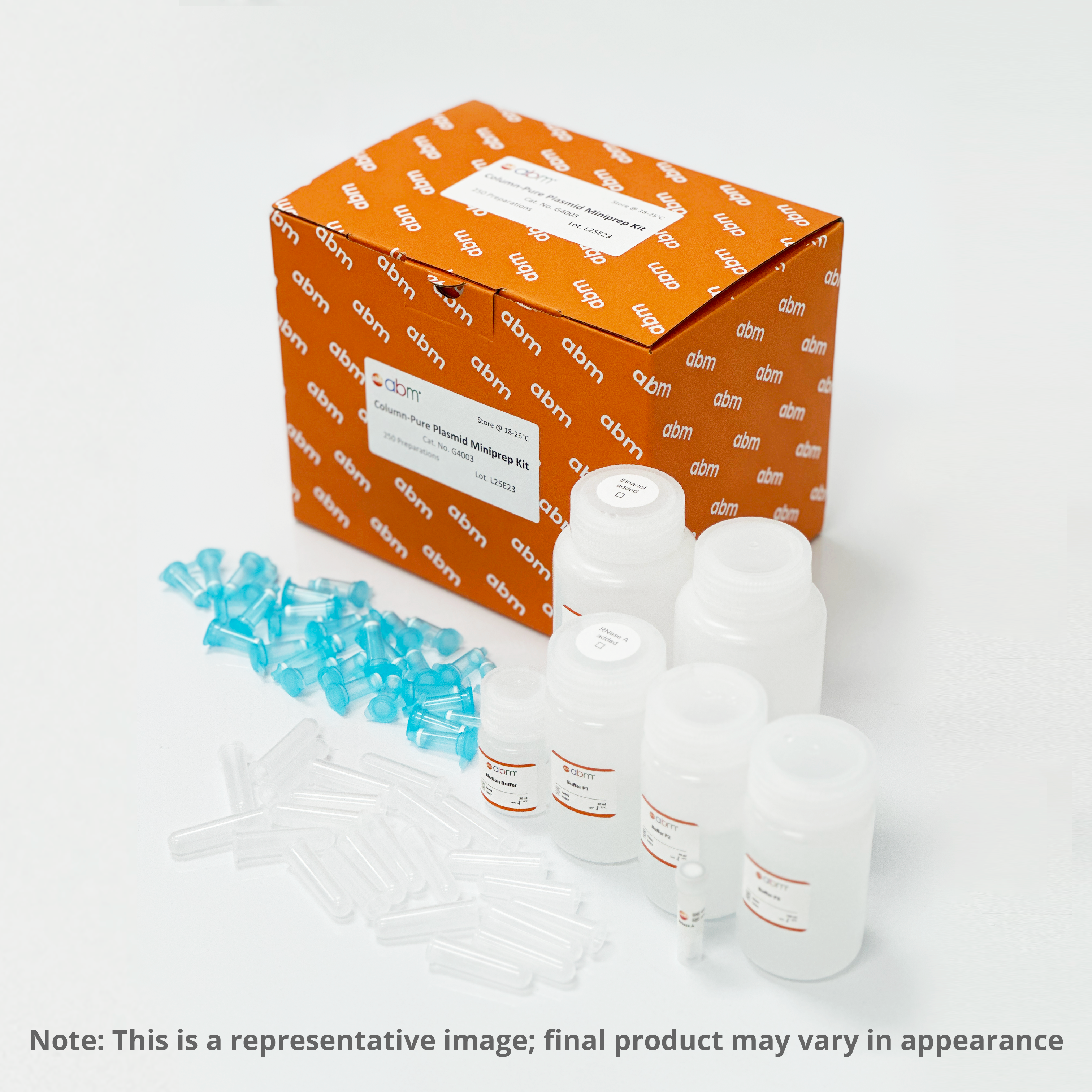


| Cat. No. | G4003 |
| Name | Column-Pure Plasmid Miniprep Kit |
| Unit | 250 Preparations |
| Description |
abm’s Column-Pure Plasmid Miniprep Kit utilizes the standard alkaline lysis method with silica spin column technology to rapidly extract and purify plasmid DNA from cells. The extracted high quality plasmid DNA is primarily in supercoiled form and is ready for downstream applications such as PCR, restriction digest and sequencing. Principle: The procedure involves an alkaline lysis method to break down bacterial cells, followed by DNA adsorption onto silica in the presence of high salt. The unique silica membrane replaces traditional glass or silica slurries, streamlining the plasmid DNA preparation. The process includes three steps: 1) bacterial lysate preparation and clearing via alkaline lysis, 2) transfer of the supernatant to a column for DNA binding, and 3) washing away proteins and impurities, followed by nucleic acid elution with a low-salt buffer. Key Features:
|
| Storage Condition |
The kit components can be stored dry at room temperature (15-25°C) and are stable for at least 18 months under these conditions. If any precipitates form in the buffers, warm at 37°C to dissolve. After addition of RNase A,Buffer P1 is stable for 6 months when stored at 2-8°C. |
| Note |
Retired Cat. No. D514. |
| Material Citation | If use of this material results in a scientific publication, please cite the material in the following manner: Applied Biological Materials Inc, Cat. No. G4003 |
| What is the binding capacity of the miniprep columns? | |
|
Up to 35 µg plasmid DNA from 1-5 ml of bacterial culture.
|
| What yield should I expect from this plasmid extraction kit? | |
|
Typically 5-25 µg plasmid DNA per 1-5ml culture. This is also highly dependent on plasmid copy number, bacterial strain and culture conditions.
|
| Why are my plasmid yields low? | |
|
There are several possible reasons including: use of a low-copy plasmid, poor cell lysis, incomplete neutralization step, culture has not grown enough, culture is overgrown leading to overloaded/clogged spin column.
|
| Why is my plasmid DNA contaminated with RNA? | |
|
RNA contamination may result if RNaseA was not added to P1 Buffer, RNaseA has degraded due to improper storage, overloading spin columns, incomplete lysis and neutralization steps, or skipping additional wash step.
|
| How should I store my plasmid DNA? | |
|
Plasmid DNA should be stored at -20°C for term, or 4°C for short term. Avoid repeated freeze/thaw cycles to prevent degradation.
|
| Can I use water to elute the DNA? | |
|
Yes, water can be used to elute DNA from the spin columns. For best results, ensure the water is nuclease-free and the pH is between 7-8.5. We recommend eluting with the provided Elution Buffer if you intend to store the DNA long term. This is because the buffer contains EDTA which can help inhibit metal-dependent nucleases.
|